What movement analysis can — and cannot — tell your care team
Computer vision can count repetitions, estimate joint angles and flag asymmetries. It cannot examine you, diagnose you, or replace clinical judgement. Honest boundaries make better tools.
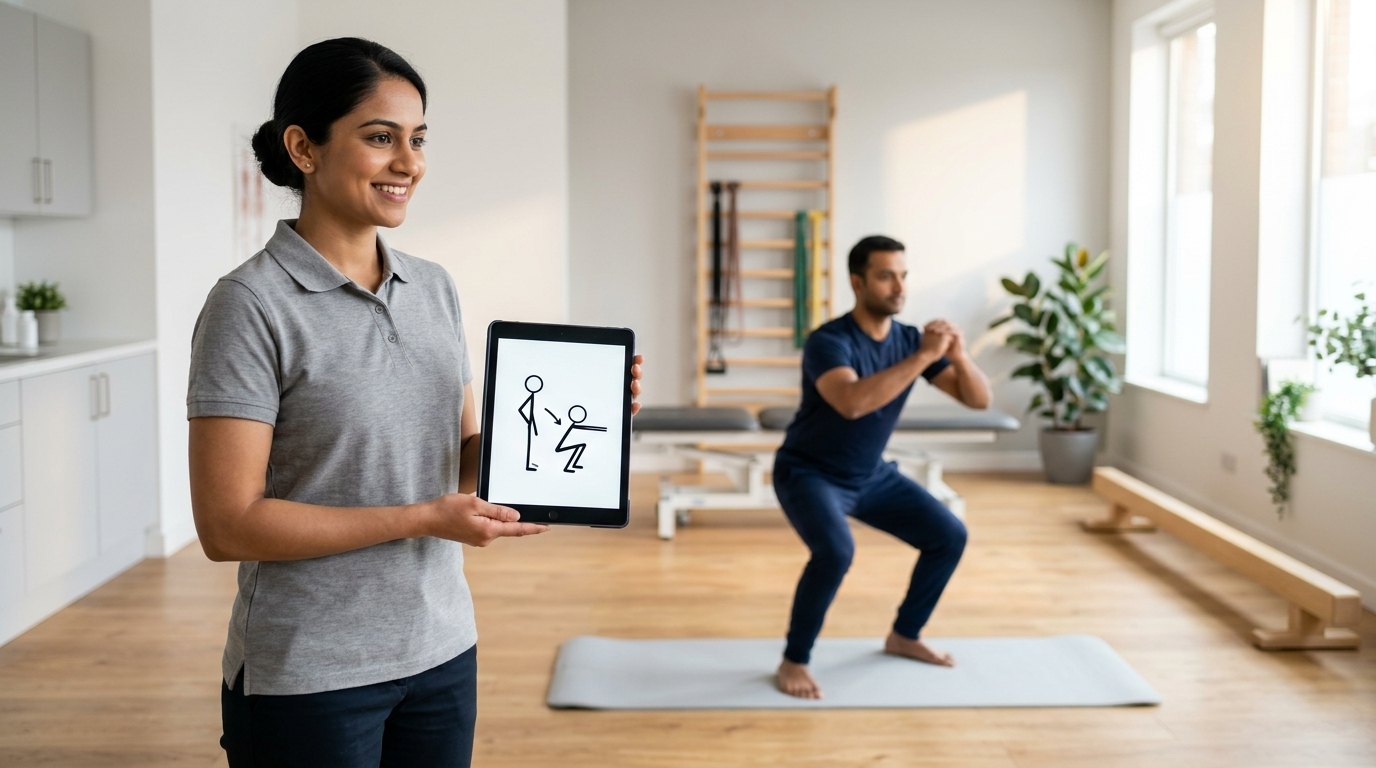
What camera-assisted movement analysis does well
Modern computer vision can identify body landmarks from an ordinary smartphone or laptop camera and turn them into structured data: joint angles, repetition counts, movement tempo, left-right symmetry. For supported exercises, this happens with no wearables and no specialised equipment.
Used well, this solves a real problem in rehabilitation: the gap between sessions. A therapist sees a patient for forty-five minutes a week; the other hundred waking hours were previously invisible.
Good rehabilitation technology does not try to be the clinician. It tries to give the clinician better eyes between sessions.
Where the technology genuinely helps
Adherence is the clearest win — knowing whether exercises happened at all changes how a therapist plans the next session. Form monitoring adds a second layer: catching a squat that drifts into valgus, or a shoulder press that shortens its range as fatigue sets in.
Longitudinal trends matter most. A single angle estimate has error bars; a four-week trend of improving knee flexion is meaningful signal that helps professionals make better-informed decisions about progressing or adapting a plan.
What it cannot do
It cannot take a history, palpate a joint, understand your life, or weigh the psychosocial factors that shape recovery. It cannot diagnose. A camera sees movement; a clinician sees a person.
This is why PranIQ's position is deliberate: technology-generated measurements support rehabilitation professionals and are always identifiable as technology-assisted information. Diagnosis and clinical decisions remain with appropriately qualified healthcare professionals.
The standard worth holding
As AI enters rehabilitation, the question to ask any platform is not 'how smart is your AI?' but 'how honestly does it define its role?' Tools that augment professionals make rehabilitation more measurable. Tools that claim to replace them make it less safe.
This article is for general information and does not constitute medical advice, diagnosis or treatment. Individual decisions should be made with appropriately qualified healthcare professionals.